Journal field note
The patch that held the elbow rigid
We patched a worn elbow with the stiffest cloth in the drawer. The repair held, and the jumper stopped bending, so we unpicked it.
We patched a worn elbow with the stiffest cloth in the drawer and it held beautifully, which was the problem. The jumper is a fine lambswool crewneck, soft enough that the cuffs have gone slightly limp, and the elbow had thinned to a pale patch the size of a thumbprint. We chose a heavy cotton twill from the scrap bag because its colour matched best under the kitchen light, and because it was the piece we could find without moving the sewing box.
The method was sound in every respect except the cloth. We trimmed the frayed fibres, basted the patch flat with a loose running stitch, then worked a close grid across it with strong linen thread, pulling each row firm so the patch sat down into the wool. It looked deliberate. It looked, in the flat light of the table, like the sort of repair that gets photographed.
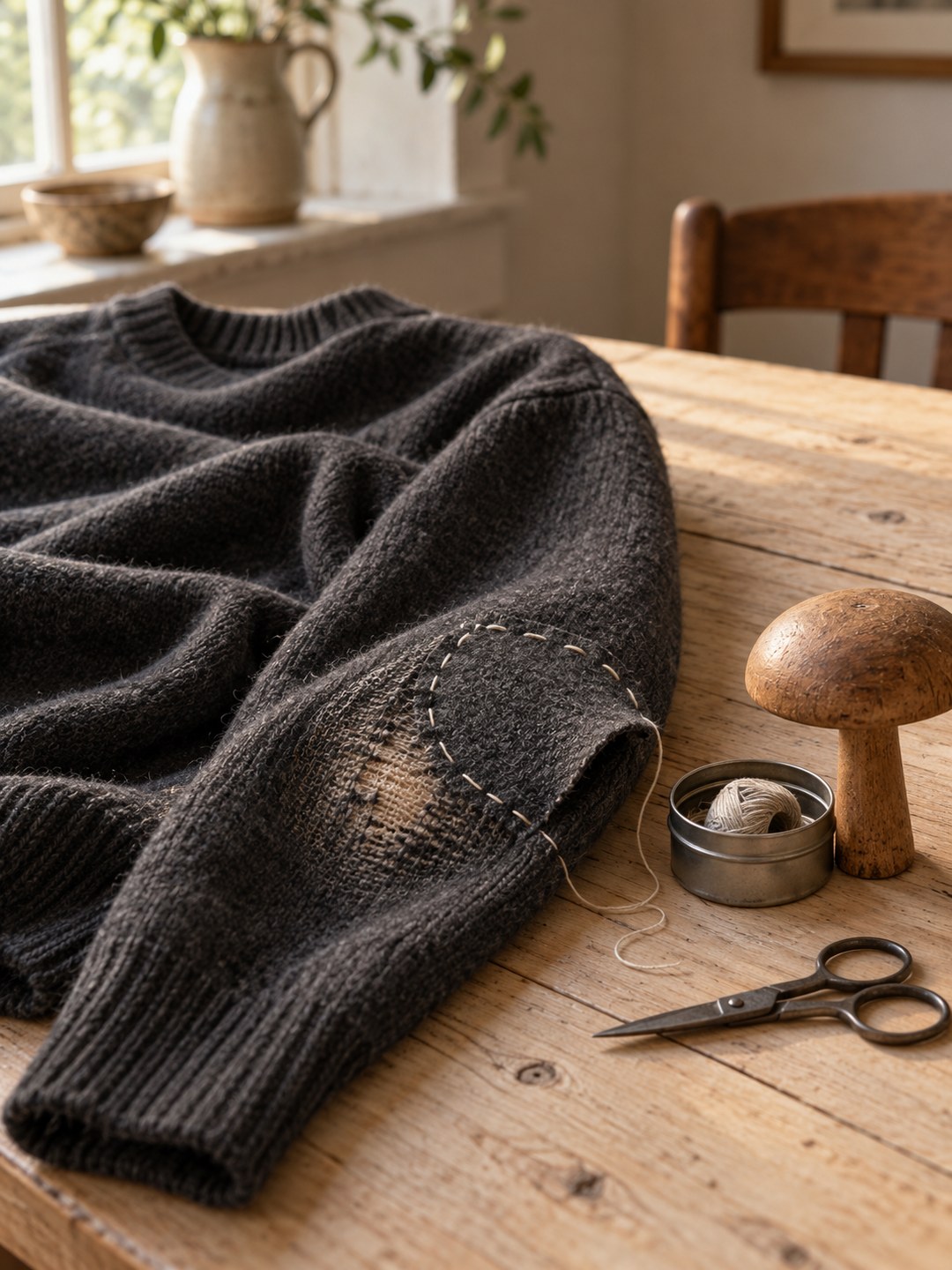
The first wearing told us. A jumper bends at the elbow roughly two thousand times a day, and this one no longer could. The stiff patch held its shape and the wool around it had to do all the moving, so the fabric puckered in a ring just outside the stitching and the sleeve pulled at the shoulder seam. By the end of the afternoon the elbow had a permanent crease where the patch refused to fold, and the seam above it had begun to strain in a way that would eventually become a hole.
The cost was an evening and a fortnight of the jumper sitting on the chair. Unpicking took forty minutes, because the linen thread was stronger than the wool and every second stitch had to be cut rather than pulled. It left a line of needle marks around the patch and lifted the nap where the basting had been. We washed it, dried it flat, and left it alone for two weeks while we thought about what we had actually done wrong.
What went wrong was not the stitching and not the tension, though both were too tight. It was the weight. A patch becomes part of the garment, and a garment moves as one piece. Put a stiff square into a soft sleeve and you have not reinforced the elbow, you have created a hinge with only one working side. The wool takes the strain at the boundary because the patch will not take any.
The correction is a rule we now follow without discussion: match the weight and the stretch before you match the colour. We cut a patch from a worn-out woollen sock of a similar gauge, slightly darker than the jumper, and basted it with a single loose row, then worked small running stitches from sound cloth across the worn area and into sound cloth on the far side, leaving the outer rows unanchored so the sleeve can move. The thread is wool, not linen. Tension is slack enough that the patch lifts a little when the elbow bends.
The second repair is not as tidy. The patch is visible, the stitches are uneven, and one corner has already begun to curl slightly. It also bends with the sleeve, which is the entire point, and after three washes it has settled into the garment as though it had always been there. We check it after drying, flat and shaped by hand, and add a stitch at any edge that has started to lift.
The second repair took an hour and ten minutes, including the basting, and the wool thread came from the same sock as the patch, so it cost nothing but the evening. The scrap bag is now two bags, one for fine knits and one for heavy cottons, sorted by weight rather than colour, and the sewing box has a card in it with the word weight written on it in pencil. The jumper is on the chair by the window with the sleeve turned out, waiting for the last two inches of the outer row.