This week's work ·
Spring onion omelette, with the pepper measured before the pan
Sweetened spring onions, folded eggs and a little cheese make a small meal worth slowing down for. Prepare the filling first; choosing a pepper mill can wait until the one you own needs replacing.

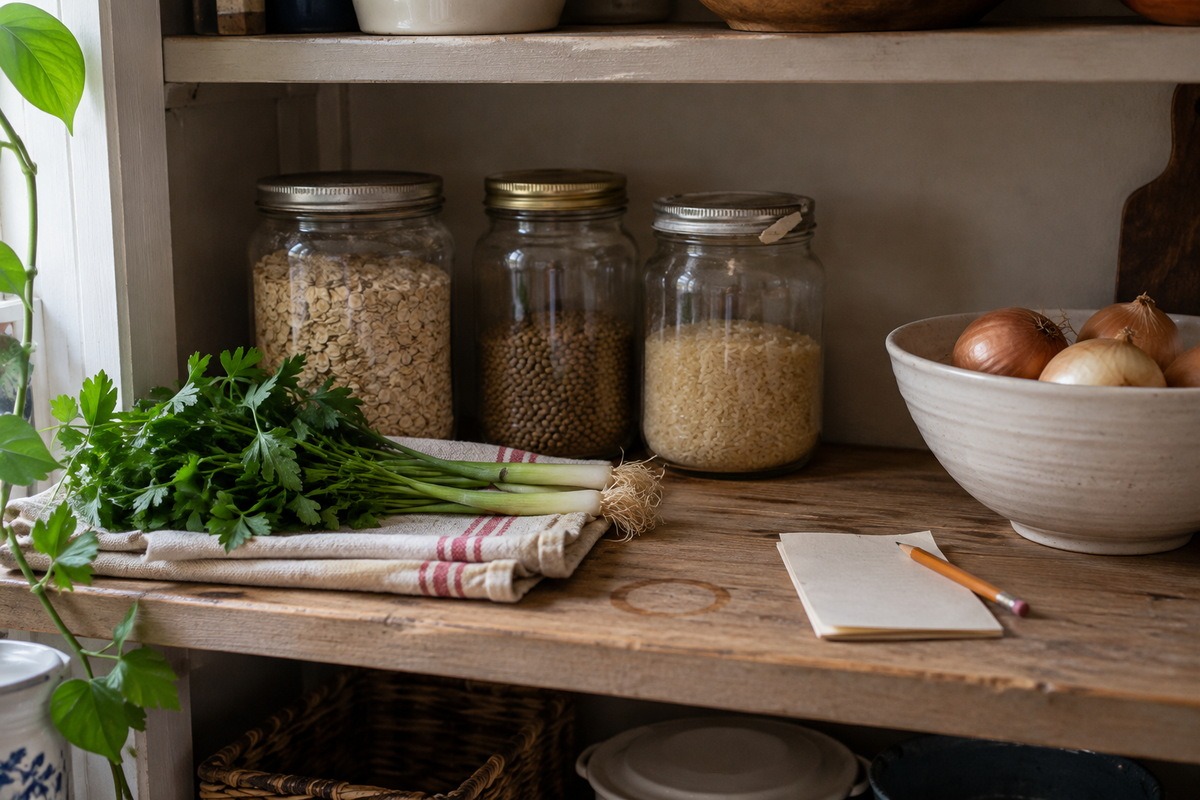
Spring onions give you two colors to scatter across the board and very little waste once the roots and tired tips are trimmed. Wash them carefully, dry them and slice the white and green parts thinly. Let the butter soften the onions before the eggs go into the pan. That small head start is more useful than trying to make every part of supper happen in five minutes.
This is a comfortable job to share: one person can slice the onions while the other beats the eggs and grates the cheese. Put a clean serving plate beside the stove before cooking. The filling needs somewhere to wait, and the folded omelette needs somewhere different to land; a bowl that held raw eggs is not a serving dish.
Set up for the fold, not a race
The recipe makes one four-egg omelette to divide between two people. Use a suitable skillet with room for that quantity and the fold, rather than assuming a ten-inch pan has enough working space because its label sounds familiar. A nonstick or well-seasoned surface can help, but neither the price of the pan nor an illustration guarantees release. Use a utensil compatible with the cooking surface.
Medium heat is a starting point, subject to the pan maker's instructions and what the butter is doing. Reduce the heat if it is browning too quickly. The aim is to set the eggs without scorching the underside. Lift the cooked edges gently and tilt only as far as you can safely control, letting uncooked egg reach the exposed pan.
Soft texture need not mean a liquid center. After adding the onions and cheese and folding, continue gently until the egg is cooked through. Check the center with a suitable food thermometer: egg dishes should reach 160°F (71°C). The clock does not establish doneness, and a moment on the serving plate is not a substitute for finishing the cooking.
There are two fats with different jobs here. Both tablespoons of butter go into the pan in separate stages; the tablespoon of olive oil is divided over the finished portions. The measured fine salt goes into the eggs. Cheddar and pecorino bring different amounts of salt of their own, so taste a safely cooled bite before adding the optional flaky finish.
A quarter teaspoon, not a count of turns
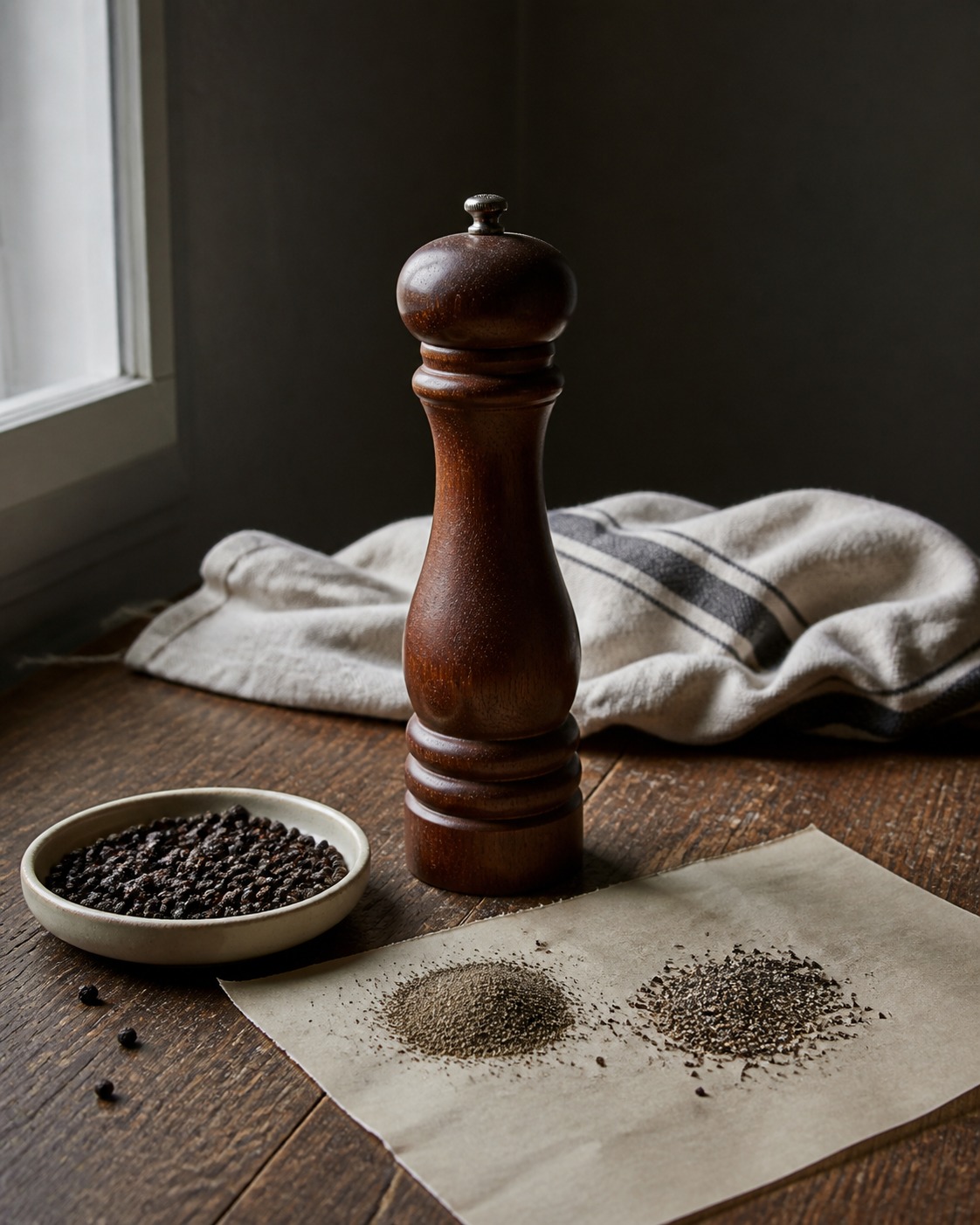
Measure the pepper before heating the skillet. Grind into a small dry dish away from steam, then take the quarter teaspoon for the eggs. Different mills and settings produce different amounts per turn; counting twists cannot replace the spoon. Keep the grinder back from the burner while the omelette cooks.
An existing mill or suitable ground black pepper is enough. If a replacement is needed, the useful comparison is between adjustment, refilling and care—not between an ordinary omelette and a premium one.
The mid-priced OXO Good Grips Contoured Pepper Grinder uses a sliding tab with five settings, a clear acrylic reservoir and a non-slip turning grip. It has stainless-steel accents, not an all-steel body or grinding mechanism: the mechanism is ceramic. This is one manual pepper grinder, supplied with black peppercorns.
The tab and visible fill level make it a practical everyday choice. Comfortable turning and top-grinding storage are useful strengths, with fewer stray grounds on the worktop. Its closure is the compromise: the refill cap can be awkward to remove or seat, or loosen and spill peppercorns. Output and the distinction between settings can disappoint too. Easy adjustment does not guarantee that every texture or refill will satisfy.
The higher-priced Peugeot Paris u'Select has a chocolate-finish beechwood body, nominally 22 cm and sold as a 9-inch mill. Its pepper mechanism is case-hardened steel; six marked settings sit on a base ring. It is one manual mill supplied without peppercorns. The curved wooden form and smooth turning are reasons to consider the extra cost, rather than evidence of a better egg dish.
Peugeot has its own inconveniences. Hold the body above the adjustment ring to avoid moving the setting as you grind. Feeding can be intermittent, top refilling can be finicky, and the wooden collar can split. Those problems are not inevitable, but the higher price does not rule them out. The lifetime mechanism warranty is separate from five-year manual-mill coverage, with conditions and exclusions; neither is a promise that the whole object lasts forever.
Choose OXO for the lower outlay, visible contents and tab adjustment. Choose Peugeot if its wooden shape and base-ring layout matter enough to accept the added cost and dry-care requirements. Their usable reservoir capacities have not been independently matched, so the taller mill is not a demonstrated answer to fewer refills.
Keep both away from steam and wet counters. For Peugeot, use suitable dry peppercorns no larger than 6 mm, turn clockwise, keep salt out and follow its emptying, soft-brush and dry-cloth care. Follow the supplied OXO instructions for its different construction. Neither mill belongs beside the sink while the egg bowl is washed.
On a small screen, scroll the table sideways to compare both choices.
| What matters | OXO Good Grips Contoured Pepper Grinder, single | Peugeot Paris u'Select pepper mill, chocolate, 22 cm / marketed 9-inch |
|---|---|---|
| Budget | mid-priced | higher-priced |
| Construction | Clear acrylic reservoir, stainless-steel accents, ceramic grinding mechanism, non-slip grip | Chocolate-finish beechwood body with case-hardened steel pepper mechanism |
| Included pieces | One manual pepper grinder; peppercorns included | One manual pepper grinder; peppercorns not included |
| Best fit | Compact daily seasoning, visible fill level and top-grinding storage | Traditional wooden form, smooth turning and marked ring adjustment |
| Worth knowing | Refill closure can be awkward or loosen; inconsistent output and grind contrast; no lifespan promise | Finicky refill; intermittent feeding; wooden collar can split; higher price does not establish longer life |
| Care | Follow supplied OXO care instructions; do not assume another mill's washing method applies | Keep dry; soft dry exterior cloth; empty and soft-brush mechanism; clockwise grinding; suitable peppercorns up to 6 mm, not salt |
| Grind settings | 5 | 6 |
| Adjustment | Sliding tab | Base ring |
| Nominal height | Not specified here | 22 cm |
| Usable reservoir capacity | Not established; height is not refill volume | Not established; height is not refill volume |
| Warranty | Better Guarantee covers normal-household-use material/workmanship defects subject to care and product terms; refund requires original receipt | Lifetime mechanism coverage is distinct from the five-year manual-mill warranty; proof, care and exclusions apply |
Check current price: OXO Good Grips Contoured Pepper Grinder, single
Check current price: Peugeot Paris u'Select pepper mill, chocolate, 22 cm / marketed 9-inch
02 · The recipe
Spring Onion Omelette
Sweetened spring onions, folded eggs and a little cheese make a small meal worth slowing down for. Prepare the filling first; choosing a pepper mill can wait until the one you own needs replacing.
- Prep
- 5 min
- Cook
- 10 min
- Total
- 15 min
- Yield
- One four-egg omelette, 2 servings
Untested approximate 5min prep+10min cooking=15min plan; trimming, heating, fold and checked doneness can extend. Bread separate. FoodSafety.gov egg-dish endpoint160F/71C is safety guidance, not a reproduced recipe test.
What you'll need
- 4 large eggs
- 1/2 teaspoon fine sea salt
- 1/4 teaspoon freshly cracked black pepper
- 2 tablespoons unsalted butter, divided
- 4 spring onions, trimmed and sliced thin, white and green parts
- 1/3 cup grated sharp cheddar or pecorino
- Flaky sea salt, to finish
- 1 tablespoon olive oil
Useful equipment
- Existing suitable skillet with room for four eggs and fold; no diameter-only fit guarantee
- Surface-compatible spatula
- Stable board and suitable knife
- Egg mixing bowl and fork or whisk
- Clean heat-safe filling plate and separate serving plate
- Suitable food thermometer
- Dry oven mitts and heat-safe surface
- Dry dish and measuring spoons
- Existing pepper mill or ground black pepper
Method
- Wash, dry, trim and thinly slice the spring onions on a stable board. Grate the cheese and keep it chilled until needed. Grind pepper into a small dry dish away from the stove and measure 1/4 teaspoon. Beat the four eggs with the full 1/2 teaspoon fine salt and measured pepper until uniform. Wash hands and clean any surfaces or utensils contaminated by raw egg; keep the raw-egg bowl separate from serving plates.
- Use a suitable nonstick or well-seasoned skillet with room for a four-egg omelette and its fold; do not infer fit from diameter alone. Following the pan maker's guidance, melt 1 tablespoon butter over medium heat, reducing the heat if it browns too quickly. Cook all the spring onions, stirring, until softened, about 3 minutes. Transfer them to a clean heat-safe plate.
- Melt the remaining tablespoon butter in the same skillet. Pour in all the beaten eggs. Let the edges start to set, about 30 seconds, then gently draw the set edges inward with a surface-compatible spatula. Carefully tilt the pan to let liquid egg reach the gaps, keeping the handle controlled and protecting hands from heat. Reduce the heat if the underside colors before the top sets.
- When the egg is mostly set, divide the softened onions and full 1/3 cup cheese over one half and fold the other half over them. Continue cooking gently until the center is cooked through, checking 160°F (71°C) with a suitable food thermometer. Do not serve a liquid center just to meet the estimated time; heating and doneness may require longer.
- Transfer safely to a clean serving plate and divide into two portions. Divide the full tablespoon olive oil over them. Taste a safely cooled bite before adding flaky salt as needed; do not add an unmeasured second pepper dose. Serve promptly, allowing bites to cool enough to eat, and refrigerate leftovers promptly. Keep the hot skillet on a heat-safe surface with its handle out of the way; use dry oven mitts where needed.